
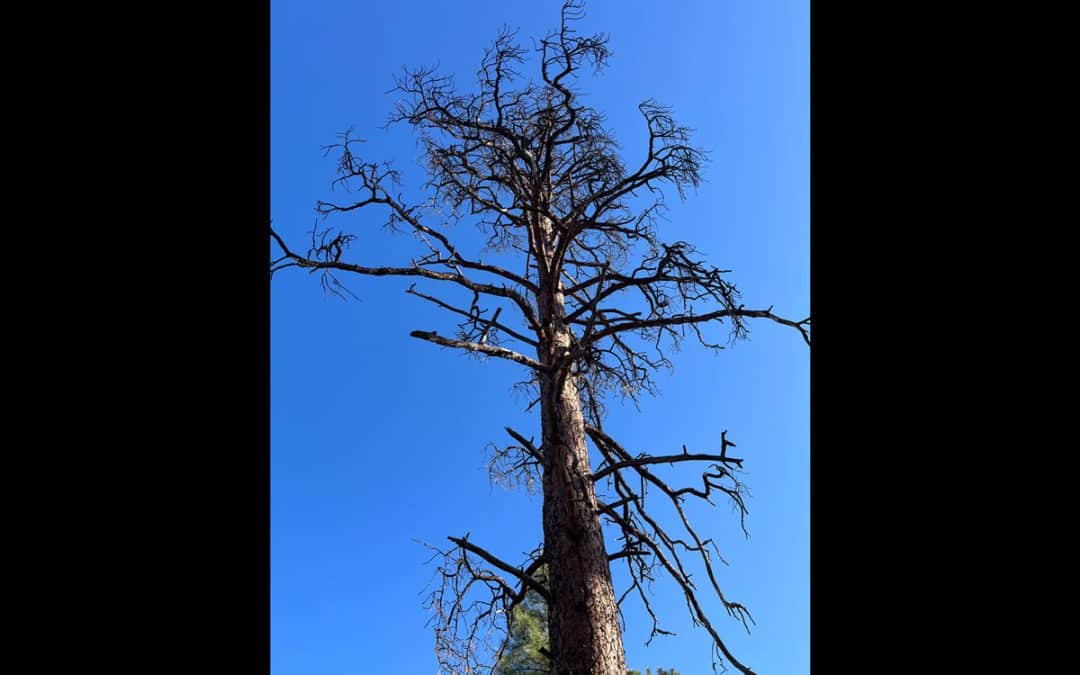
Lately I’m reflecting on the importance of pine trees in my life. On one of my hikes in the White Mountains last month, I came upon this Ponderosa pine. Yes, it’s dead, but it’s still standing. Ponderosa pines can live for over half a century, so I found myself thinking of it as a type of monument, bearing witness even in death to all that it saw in its long life.
The town of Lakeside, where I was staying, abuts the Fort Apache Indian Reservation. In fact, I hiked up to the reservation boundary a couple different times during my stay. I encountered this tree in that buffer area between the town and the reservation. I found myself wondering whether this tree bore witness to confrontations between the migratory Apache peoples and my social ancestors. European Americans essentially invaded Apache territory, thinking it was free for the taking because they didn’t see established settlements. I wonder if there might even be arrows buried deep in this tree’s interior.
Such monumental Ponderosa pines can and do bear witness to us about their lives, as they are one of the primary trees used in the desert southwest for dendrochronology, or tree-ring dating. I learned about this technique as a child because my mom is an amateur archaeologist. Each year of growth is distinctly marked as a ring in the tree’s trunk. Scientists’ accumulated knowledge of how weather conditions affect tree growth over time allows them to read tree rings like a historical map. (There’s even a building dedicated to this work on the University of Arizona campus.)
So, if this tree were cut down (or after it eventually weakens and falls), scientists could cut a slice from its trunk and determine exactly when it lived. They’d learn whether it lived in a time of plenty or drought and get some sense of what it might have seen. While we cannot understand the language trees speak, we are learning more about how trees communicate. I wonder what they would say to us about our relatively brief and seemingly nomadic lives.
What monumental trees have you encountered in your life? What might they have witnessed in their long lives?


The most monumental tree I’ve encountered was known simply as The Big Tree, in the Gila National Forest near Silver City, NM. It’s the second largest alligator juniper ever recorded, and is reached by a trail near Fort Bayard Military Reservation. It stands 63 feet tall, has a crown span of 62 feet, and has a circumference of 18 feet, 4 inches. Imagine a juniper tree that big! Oh, the stories it must be able to tell! I’m just glad it’s been preserved for future generations to see. I recommend a trip there for folks who like to hike.
Thank you, Aston, for reminding me of the Big Tree! I actually visited it when I lived in Silver City. It is indeed monumental–and probably has quite a few stories to tell….
Peace,
Shirin