
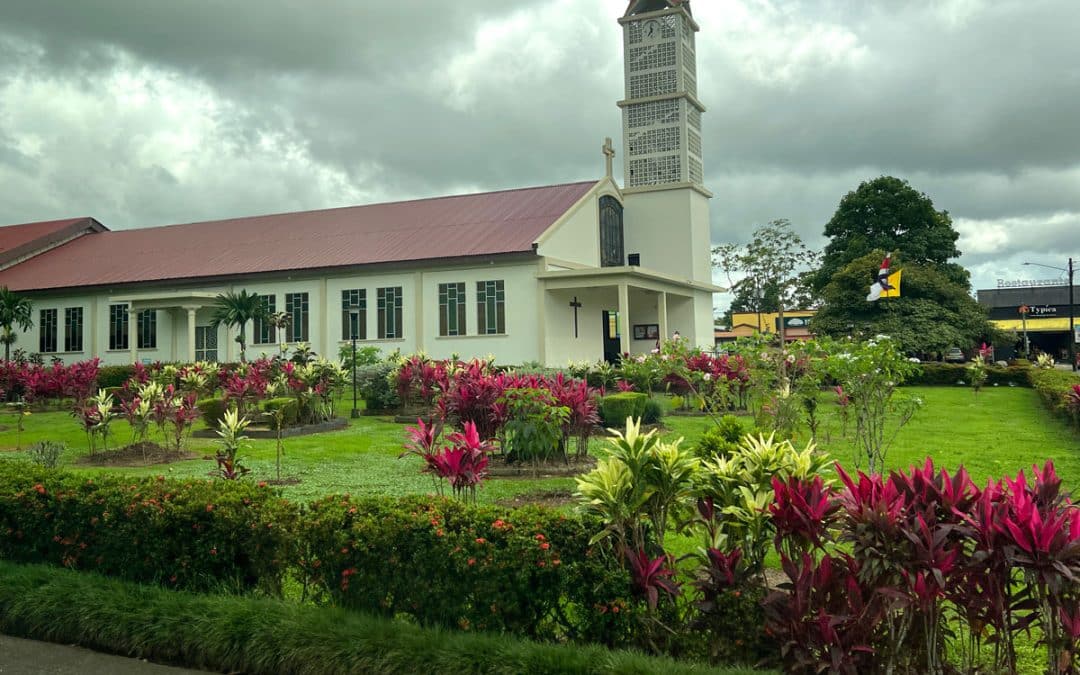
We were in Costa Rica on August 2, which is the Feast of Our Lady of the Angels, honoring the country’s patron saint, popularly known as La Negrita. It’s estimated that as many as two million people—out of a population of 5.5 million people—participate in the Virgen de los Ángeles pilgrimage each year. That’s 40 percent of the country! Roads leading into Cartago (the old capital city) are overwhelmed, and part of how we ended up talking about the pilgrimage was our bus driver’s concern that we might encounter some of that traffic.
We didn’t encounter the traffic, but we did see several groups of people walking along the side of the road. (Unfortunately, I never had my phone in hand quickly enough to get a picture, so the picture above is of the Catholic church in La Fortuna, in another area of the country.)
Many people walk the 22 kilometers (13+ miles) from San Jose, the modern capital, to the Catholic Basilica in Cartago. More travel by foot over several days from across Costa Rica (which is the size of West Virginia) to Cartago. The pilgrimage is called Romería.
I’ve mentioned two New Mexico pilgrimages in an earlier post on pilgrimage. There’s the pilgrimage to Tomé Hill, south of Albuquerque, which I participated in when I lived there. There’s also the more well-known El Santuario de Chimayó, which I most recently visited in May on my way to Colorado. I hadn’t been there in ten years, and a lot had changed.
These pilgrimages are meant to be repeated, usually yearly, but others tend to be once-in-a-lifetime experiences. One of my fellow travelers in Costa Rica is planning to walk part of the Camino de Compostela in Europe next summer—something my aunt and several friends have also done. For Muslims, there’s the Hajj pilgrimage to Mecca. In Japan, there’s the Kumano Kodo, which, with the Camino, are the only UNESCO-recognized pilgrimage walks.
Over the course of human history, there have been pilgrimage routes to many places. One recently retired friend and his wife have taken several weeks-long pilgrimage hikes over the years, and they are headed abroad to complete part two of their Jerusalem Way pilgrimage soon. In addition to Tomé Hill, I have been a pilgrim in the Holy Land on two occasions, though most of my travel was by plane and bus!
There are also many ways to participate in pilgrimage. That fellow traveler I met in Costa Rica invited me to consider joining the Camino pilgrimage she and her friend are taking next summer. After prayerful discernment, I’m not feeling the call to do that. I sense that my camino right now needs to be more internal, as God is inviting me into a therapeutic season of remembering, processing, and releasing.
What does pilgrimage mean to you? What pilgrimages have you participated in—or longed to do but haven’t? How has a pilgrimage or other travel shifted your perspective or altered your relationship with the Divine?


In the Baháʼí Faith, pilgrimage is a once-in-a-lifetime requirement if you can afford. You travel to the Baháʼí World Centrer in Haifa and ʻAkká, Israel. You spend 9 days praying at the Shrine of the Báb on Mount Carmel amidst lush gardens and visiting the quiet surroundings near ʻAkká where Baháʼu’lláh lived. It is inspirational sharing those nine days with fellow travelers believers from all around the globe. It manifests the Baháʼí quote, “The earth is but one country, and mankind its citizens.”
Thank you for sharing your experience with pilgrimage, Melissa. I love the reminder of gathering with believers from across the globe. I’m glad it was a blessing for you.
Peace,
Shirin
I walked the “romería”with a group a couple years ago. I feel the biggest spiritual benefit is to, “get out of one’s head” about prayer in particular & our “walk with God” in general. I might add that the person who brought me along is a grandmother several years my senior. I struggled to keep up with her!
Thank you for sharing your experience with romería, Alex. It does sound like an amazing experience for pilgrims…and how wonderful that you were able to share it with a grandmother in the faith.
Peace,
Shirin
I grew up making pilgrimages to Knock, where Our Lady is supposed to have appeared.
Now, my pilgrimages are to rugby stadiums!
One expectation of pilgrimage is to experience some sort of personal transformation. For a lot of people, the Camino is transformative. Do we really need to travel to gain distance from how we are living to change how we are living? I don’t think so…
Since my sabbatical I’ve been focused on spying on the divine around me “in place” because sometimes I don’t need to travel somewhere to find what nourishes my soul.
But this is just me, at this moment in time.
Thank you, Damien, for sharing your experiences and your perspective on pilgrimages. I love the idea of watching out for the divine wherever we are; I sense that we’d love where we live a lot more (or at least not take it for granted) if we did that on a regular basis….
Peace,
Shirin