
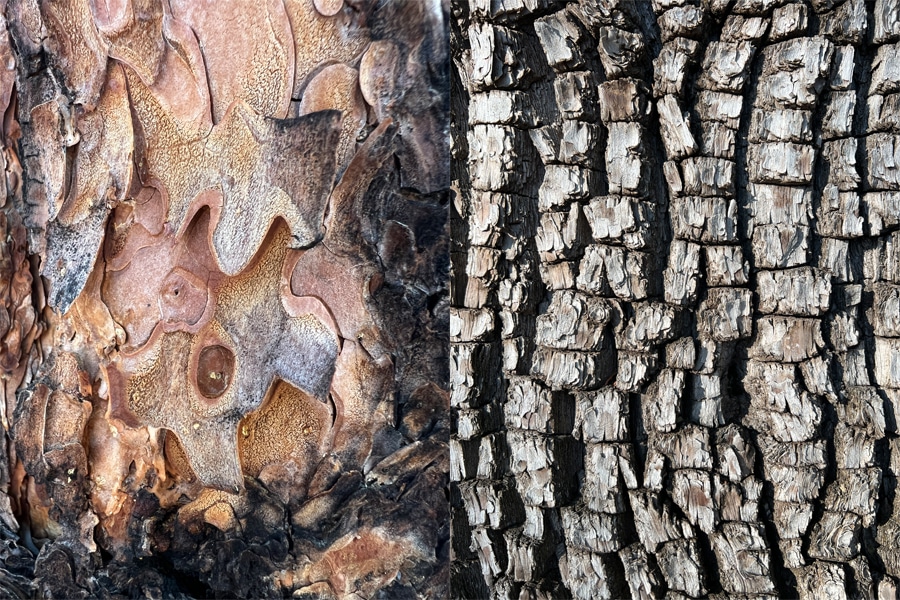
Last month, I was blessed to spend more than a week (a combination of working and retreat days) in the White Mountains of northern Arizona. (I wrote about my last visit to this place here.) It was such a gift to be back amongst the Ponderosa pines. As I took morning walks through the forest and hung out near small mountain lakes and meadows, I found myself pondering and photographing many things, including distinctive—and distinctively different—patterns of tree bark.
I marveled at the infinitely varied jigsaw-puzzle layers on beloved Ponderosa pine trees and the thick, grid-like blocks of layered bark that the alligator juniper wears. (Samples of both are pictured above.) Not for the first time, I wondered what made various species of tree bark so distinctive, as opposed to the simple color differentiations across diverse types of human skin.
At some point in school, I learned that our skin, the epidermis, has three layers. This is why we can scrape or scratch ourselves and not always bleed. Is the same true for tree bark? Do the creases and crevices I glimpse in tree bark, like my own increasingly wrinkled skin, still prevent dirt and disease from getting through?
It turns out, like with so many things in nature, the answer is yes—and no. In relatively simplistic terms (you can learn more details here), the thick bark layers pictured above are dead skin that sloughs off trees much more slowly than dead skin sloughs off humans. The living layers are hidden and protected beneath the visible bark—and its dead inflexibility causes cracks and fissures to form as the tree continues to expand, grow, and flex in breezes and storms.
Also, of course, trees bleed sap if they are scraped, scratched, or slashed too deeply. So, we’re really not that different from trees after all. Their beautiful bark and our supple skin are variations on the themes of growth and protection.
As you perhaps slather your skin with protective lotion or cover it with sleeves and socks in preparation for summer adventures, I invite you to think about how deeply alike we are as trees and humans. Next time you pass a tree, take a moment to pause, admire its beautiful bark, and give thanks for your stunning skin.


Today I am two weeks post op from a knee replacement. Just this morning I was looking at my own skin – incredibly dry after 14 days of showers with antibiotic soap and limited lotion. I get discouraged by the swelling, bruising, 7″ gash and multiple staples that allowed the carpentry work on my knee to occur. And yet I appreciate the marvel of modern medicine. I trust that before long the scar will heal and my skin will again be “normal”. There will always be a reminder of this experience…and the lessons I am learning in my imposed quietness and stillness. I am hobbling on a walker and not yet out gazing at the trees – but will get there eventually and appreciate our similarities… seasons of change and growth. Thanks for the reminder!
Oh, Joyce, thank you for sharing this piece of your medical journey and reminding us of how important skin-care is. You’re also illustrating how interconnected we are as individuals and as species! I pray that your healing from and through this season of change and growth will be (relatively!) swift and complete…and that you’ll be out amongst the trees very soon….
Peace,
Shirin