
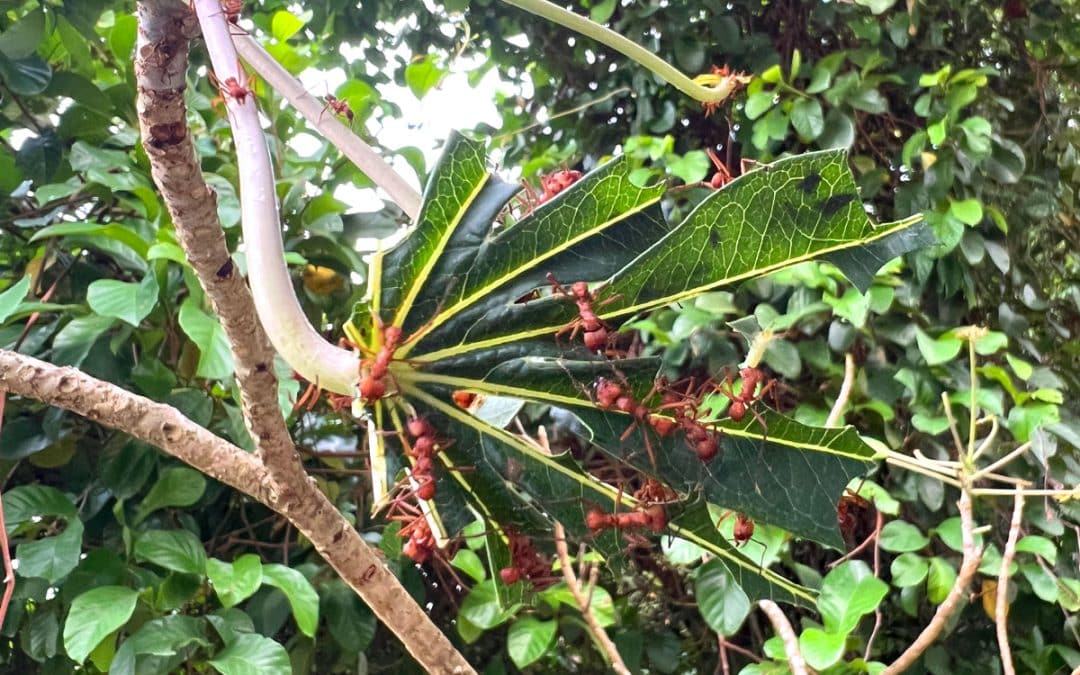
One fairly ubiquitous creature we encountered in Costa Rica was the ant. We frequently came across lines of ants, marching alongside or across our path. In fact, Luis, our guide, told us that whenever we stopped along a path, we needed to look down to make sure we weren’t standing in a line of ants. While the most painful ant bite in the world would come from the bullet ant (and we did see one bullet ant nest in Sarapiqui), the ants best known for their destructiveness were the leaf-cutter ants.

As you can see in the photo above, these ants would swarm onto a leaf and completely destroy it, one small section at a time. They even carried off pieces of stem, as you can see here. All this went into their underground nests, where they would chew up the leaves, then plant fungus spores in the resulting compost and eat from their fungus garden.
Isn’t nature amazing? What we see as destructiveness is simply part of the farming process for ants.
I found myself thinking about this in connection with a story Luis told us. After serving as a river-rafting guide, naturalist guide, and expedition guide for a US company, he was unemployed during COVID-19. He eventually found work in a call center for Amazon—yes, that retailing behemoth. After four weeks, Luis became so ill that he was unable to work. He went to the doctor, who said he was having some sort of autoimmune or allergic reaction, but it was not clear what was causing it. A couple of weeks and several tests later, he realized that being confined indoors and having to deal with the negative energy arising from call-center problems was literally making him sick. He described it as burnout. Part of the problem was that this was his first time ever working fulltime indoors.
And it wasn’t just customers’ negativity that was the problem. There were also the missing packages and incorrectly delivered items. He told us the story of a rural customer who was housebound and needed medication delivered because they couldn’t drive into town to get it. The delivery person left the package at a closed gate rather than trying to contact the customer or follow the delivery instructions. The customer couldn’t get to the medication, and it spoiled.
Luis ended up calling a local pharmacy to see if they could deliver the medication or otherwise help the client. The moment he finished that call, he was contacted by his supervisor, who asked why he was taking so much time with one customer. When he explained the situation, rather than being praised for trying to help, he was advised to follow company policies and keep the calls short.
Naturally, he quit his job with Amazon as soon as he could. The destructiveness of the call-center environment was much more damaging to him than a bite from a bullet ant, whose venom produces a period of intense pain that can last for about 24 hours.
I grieve that we humans willingly afflict this level of destabilizing destructiveness on other humans—and yet we do it all the time as a species, with war being a most obvious example. This is one reason why I made a commitment, now that I’m on my own, to avoid shopping on Amazon whenever possible. (The only purchase I’ve made in the past 18 months was a wedding gift because the couple were registered on Amazon.)
When have you become aware of the destructiveness of human practices and the negativity we can project onto others? What have you done in response?


I have stopped shopping at stores owned by many big corporations that don’t support DEI. I am trying to fight materialism, and promoting naturalizing our townhome lawn. I am trying to watch my perspective and predjudices of people, religions and cultures. It is a time to be self-vigilant in thought and action.
Thank you, Melissa, for sharing the wise choices you’re making and encouraging. It is certainly a time to be paying attention to what is ours to do!
Peace,
Shirin
Wow… What a great, if disturbing, story.
We are in late-stage capitalism, aspects of which feel designed to quench the human spirit.
Yes, we are, Damien. On this Labor Day, I note that too much of capitalism is definitely not designed with the health of the laborer in mind.
Peace,
Shirin
Luis’ story exemplifies his integrity and ethics. I have a friend whose son-in-law he disliked. After spending a week with him and his daughter he developed hives. They were not affected by benedryl. As he left for home the hives disappeared. They returned when he talked about his son-in-law to the man next to him on the plane. The mind/body/spirit are all one! If there is no emotional or spiritual outlet the body suffers.
Oh, Melissa, thank you for this powerful example of the interconnectedness of mind, body, and spirit. I’m glad that more and more of us are waking up to this truth and making wise and healthy choices for ourselves.
Peace,
Shirin