
I went “home for Christmas,” as that popular song puts it. I’ve lived in the Tucson area for ten years now, so that’s home in a very real sense. But I grew up in Albuquerque, New Mexico, and I went there to celebrate Christmas with family. We enjoyed luminarias; consumed posole, tamales, and biscochitos; and I posted an image of a Native American-themed nativity on Christmas Day. It was a very syncretistic celebration—which is something we humans do naturally.
When we embrace holidays, we make them our own. When Christianity migrated into Roman culture, it took on elements of the festival of Saturnalia, which took place in December. When it migrated to northern Europe, people equated the return of the light after the winter solstice with Christ as the light of the world. Yule logs, Christmas trees, even Santa are all syncretistic.
My Christmas celebration was syncretistic because my white, Anglo-Saxon Protestant heritage (the iconic—and too frequently idealized—WASP) involves none of the things that I mentioned in the first paragraph. They are New Mexican traditions that have their roots in the Native and Spanish history of that area. But they have become important to me because of my history as a New Mexican.
And that’s fine. If we don’t make something our own, we won’t invest it with meaning. We won’t be committed to celebrating it. We connect with our communities through shared experiences like this. It’s the way Christianity spread and how it can continue to be meaningful in an increasingly secular culture.
It’s very important to recognize that Jesus was Middle Eastern, not WASP. It’s also important for me to recognize that I’m WASP, not Middle Eastern. I cannot become Jesus, but I can seek to become the best Jesus follower I’m capable of being. For me, that’s an important element of authentically celebrating Christmas.
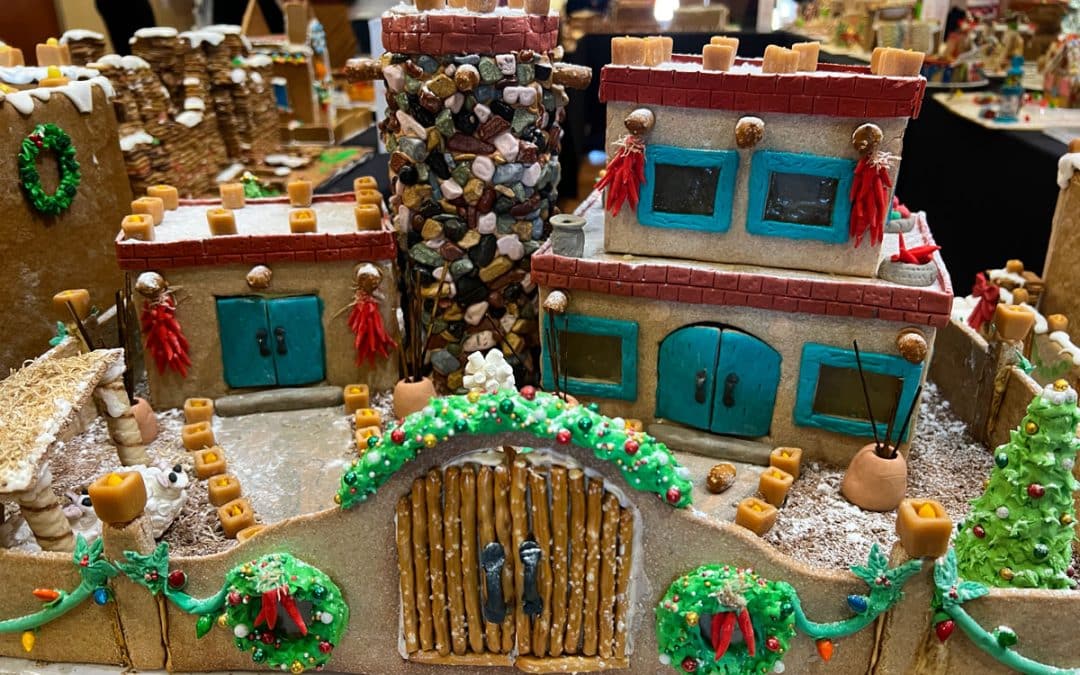
My syncretistic celebration will continue through this week of Christmastide, because another thing we did last week was visit the Indian Pueblo Cultural Center, which hosts a gingerbread house competition each year. As you can see in the image above, their gingerbread houses, while using “traditional” components, are very Puebloan. It’s another syncretistic celebration of the holidays.
What aspects of your Christmas celebration are syncretistic? Why do they matter to you?


Shirin
I recall a Christmas of decades past. Consuelo and I visited one of her cousins who lived in Mexico City. We decided to duck into a church near her cousin’s apartment. In the chancel, arranged in a semicircular landscape before the lectern, lay a prototypical New England village, its white, two-story colonial houses sparkling and its Congregational church with an elegant steeple dominating. Fake snow mounded on the branches of firs and maples. A tiny sleigh drawn by an equally tiny horse carried snugly wrapped children down the street lit by miniature streetlamps. Altogether, in a Catholic church on a Mexico City side street, Currier and Ives came to life.
Tom Hester
Oh, thank you for sharing this image, Tom! I hadn’t considered that such a wintry New England scene might be “imported” to Mexico City, so thanks for broadening my perspective. A precious memory you shared, I imagine.
Peace,
Shirin
I love that you present Christmas traditions in this way! Yes, it makes so much sense when we consider that of course everyone would develop celebrations that reflect their culture. This is such a good reminder that no one has a right to say that their way is the “right” way to do Christmas.
Having lived in New Mexico myself for twenty-eight years, I do miss the luminarias and the tamales. I’m glad we can incorporate whatever traditions are meaningful to us. I realize I haven’t answered your question, but these are the thoughts you brought up for me.
Thank you, Aston, for sharing your thoughts and what you miss from past Christmases in New Mexico. Whatever you choose to share is welcome!
Peace,
Shirin