
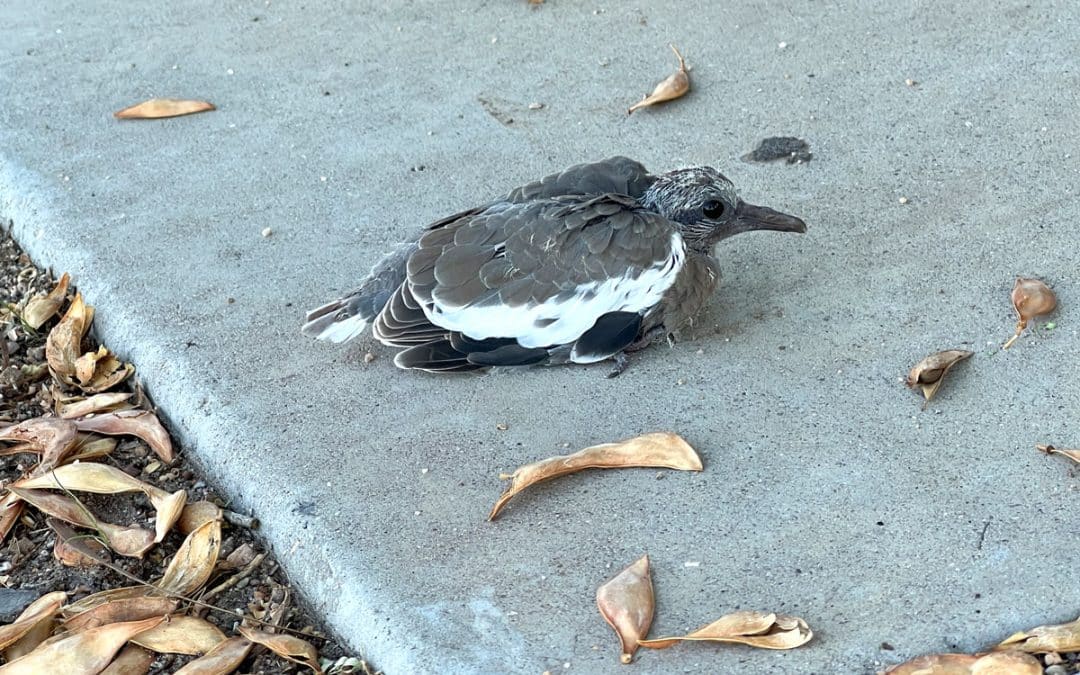
I came across this adolescent bird on my morning walk recently. Its sibling was lying dead nearby on the sidewalk. This bird was clearly still alive. It didn’t move when I came in close to take a picture, but neither did any nearby parent bird swoop in when I crouched down beside it.
I’ve read that young birds will leave the nest before they’re fully able to fly, and that confuses me. Why leave a place of safety before you’re ready to fully function? It must work for the birds as a species, or they would die off. But what advantage can there be to hanging out at ground level, where so many more predators can get at you?
I’ve also read that we should leave such birds alone when we see them, so that’s what I did. I took my picture and passed on by. But it was hard to do that. It was difficult to walk on and do nothing beyond wondering whether that bird will survive to full, flying adulthood.
Sometimes it’s also difficult to watch adolescent humans learning to navigate the world beyond their nests. I think of the equivalence between birds flying and teens driving. Both are dependent on their parents until they’ve got their license to fly and the means to do so. And unless we are their parents or in their vetted social network, we are discouraged from interfering in the process.
That can be difficult—but also freeing. There’s no way I can get to know, much less support, all the adolescents in my neighborhood. Yet I can pay careful attention to any who show up in my path. I can discern whether I am called to notice, pray, and walk on by, or if I’m called to reach out and develop a more substantive and supportive relationship.
For years, I’ve periodically asked this question: What is ours to do? I expect it will never go away. As you reflect on those who show up in your path these days, what is yours to do?


That is the question I often ask myself… I seldom have an immediate answer…
I hear you, Damien. Perhaps an important part of the process is to remember to ask the question…as it changes the way we look at the world….
Peace,
Shirin
Listen. I thank God for all those who listened to me. How many times has a person who listened to me benefited me in my decision and helped me to avoid disaster? Thank God for the listeners and those who paid attention to me even when I didn’t deserve it. Dear God, Thanks for the listeners.
Eddie
Thank you for responding, Eddie, and for your prayer for listeners. That is truly a critical role…thank you for being a listener!
Peace,
Shirin
What is ours to do? Mine to do? This keeps coming up across platforms and podcasts that interest me. It’s an urging to pay attention. I was not quite sure where you were going with the birds and young drivers. It calls me to be alert on the road for sure and maybe not so quick to be irritated with folks who are slower than I think they should be… ? new drivers? – or faster – testing the limits. Mostly it feels like a call to NOTICE my responses to others and to my myself and my own shortcomings.
Thanks, Joyce, for acknowledging both the urgency of this question and the fact that my directionality might not have been clear to you! We each do our own navigation…guided by Spirit, I believe. I’m glad you’re feeling the call to notice your responses…may it be fruitful….
Peace,
Shirin