
As I draft this post, on Friday morning of last week, a friend and fellow editor I knew back in Massachusetts is in the ICU, sedated and on a ventilator after a head-injury fall. I’m hearing occasional updates third hand from a mutual friend, who hears from the woman’s nephew. It’s a time of grief, of fear, of dwelling in the liminal space of the unknown.
You are (likely) reading this post as Holy Week has begun. Many months ago, I had this idea to write about the liminal space for the women at the foot of the cross, while Jesus hung above them. They were also in a time of grief, of fear, of dwelling in the liminal space of the unknown.
I could not have known these two stories would collide, commingle, embrace each other.
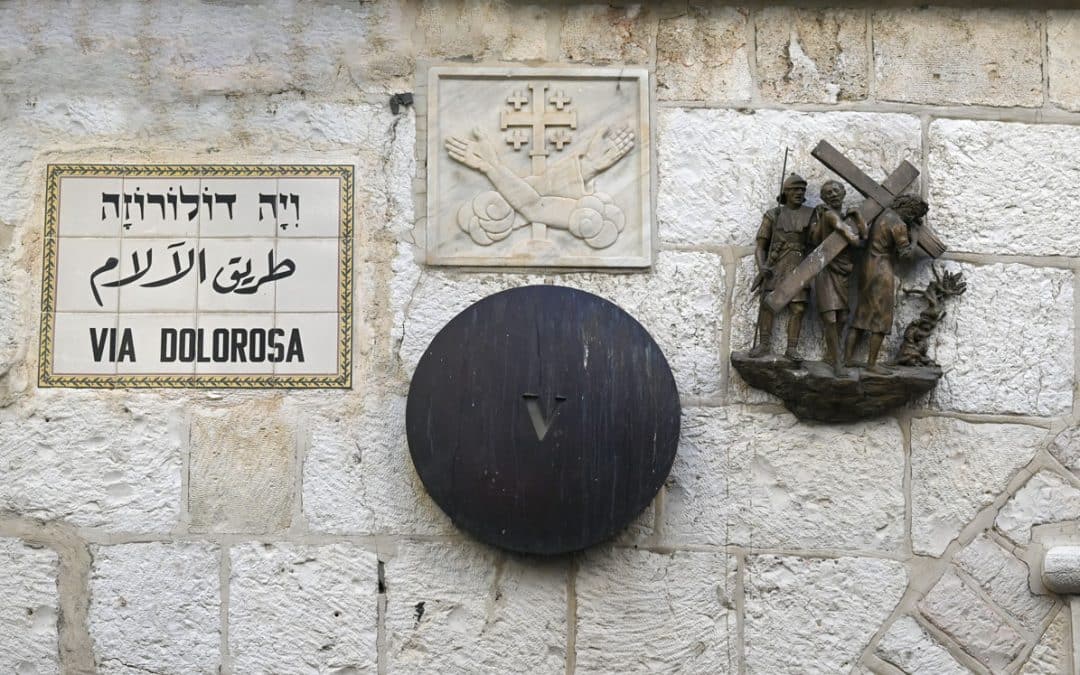
Walking the Way of the Cross is a common practice for Christians during Holy Week, especially on Good Friday. On pilgrimage in Jerusalem, we walked the Via Dolorosa, which commemorates the route Jesus took from Pilate’s headquarters to the place of his crucifixion. Across the US, churches commemorate this walk by setting up Stations of the Cross and reimagining that journey.
A couple years ago, I found myself thinking about a missing piece in that journey. The Way of the Cross includes various events and encounters on the way to Gethsemane, then Jesus is nailed to the cross—and then he dies on the cross at the next station.
I want to know what happened to those long hours in between: the waiting, the agony, the unknown, the just being rather than the doing. Why don’t we commemorate that? Perhaps because sitting in silence in the unknown is too uncomfortable. We want to focus on events, on encounters, on connection. We don’t want to acknowledge our need also to sit in silence, waiting with pain, fear, and devastating loss.
Yet we all will live in and through those spaces, and it’s important to acknowledge that reality too. The day of Jesus’ crucifixion was not just a day of action. It was also a day of excruciating contemplation. I imagine the women, huddled near the foot of the cross, going back over every aspect of the past three years—and in the case of Jesus’ mother Mary, the whole of his life, back to the angel Gabriel announcing that she would bear a child who would change the world. What must she have been saying, and thinking, as she waited at the foot of the cross, hour after agonizing hour?
I invite you, sometime this week, to spend time in silent waiting. If you wish, imaging yourself joining the women at the foot of the cross. What do you hear? What do you say? If that location doesn’t work for you, imagine yourself sitting with a loved one in the ICU, as they lie there unresponsive, or writhing in agony. What comes up for you in the waiting? What prayers rise?


Thank you, Shirin. This is so powerful especially personalized as it is. I also am residing in the liminal space “with” our friend in that ICU. Pat
I’m glad my message speaks to you, Pat, and it’s good to know who’s keeping me company in that ICU. Thank you!
Peace,
Shirin